Images of Beef Lump Jaw Images of Beef Growth on Lower Mouth
Introduction
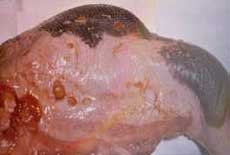
Wooden tongue (actinobacillosis) and lumpy jaw (actinomycosis) occur throughout Australia, in cattle of all breeds, age and sex. Wooden tongue is more common than lumpy jaw. Normally just a small percentage of animals are affected at whatsoever one time. The term 'actino' indicates that the inflammation acquired past these leaner results in the germination of pus containing sand-like granules. The granules are really clumped colonies of bacteria.
Cause
Wooden tongue is caused past infection with the bacterium Actinobacillus lignieresii, and lumpy jaw by the bacterium Actinomyces bovis. Mixed infections accept been known to occur, only are not common.
The bacteria, which live in the rima oris, invade tissue through breaks in the lining of the oral cavity cavity. Low-quality dry stalky feed, grass seeds, coarse hay and scrub tin can cause mouth abrasions which allow entry of infection. These factors are commonly associated with dry out times and drought. Breaks in the gums that occur as teeth erupt in young animals can too predispose to lumpy jaw. Ironically, increased incidence has also been reported after flooding.
Description
Wooden natural language
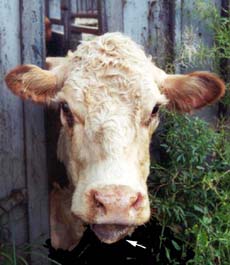
Wooden tongue occurs about entirely in soft tissue. The natural language and lymph nodes of the head are commonly involved. The disease has a sudden onset, with the tongue becoming hard, swollen and painful. Affected animals are unable to eat or drink and there is rapid loss of condition. They drool saliva and may appear to be chewing gently. The tongue oft protrudes betwixt the lips. Nodules and ulcers may be visible on the sides of the tongue.
As the affliction becomes chronic, fibrous tissue is deposited in the tongue, which becomes hard, shrunken and immobile, hence the proper noun 'wooden tongue'.
In many cases the area between the two bones of the lower jaw is swollen, giving the advent of 'bottle jaw'. The lymph nodes around the jaw may get infected, and crusade swellings under the skin which can vary in size from a golf ball to a football game. These are thick-walled abscesses that may interruption out to the surface and belch a creamy pus containing the characteristic granules. These abscesses can also occur internally, and when they are detected in the internal lymph nodes during abattoir monitoring, they may be dislocated with tuberculosis. Wooden tongue tin can too bear on sheep.
Lumpy jaw
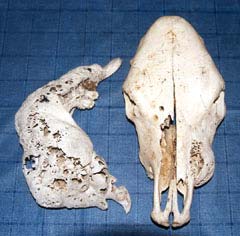
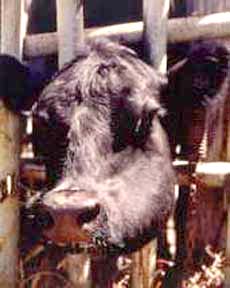
Lumpy jaw produces lumps on the upper and lower jawbones, hence the common name 'lumpy jaw'. These lumps are immovable hard swellings of the basic, usually at the level of the cardinal molar teeth. The swellings develop slowly and may take months to reach the size of a tennis ball. They consist of honeycombed masses of sparse bone filled with xanthous pus. If neglected the swellings may become very large. In avant-garde cases, sinuses or openings develop and belch small-scale amounts of sticky pus containing gritty xanthous granules. Unlike the case with wooden tongue, the local lymph nodes do not become involved.
Lumpy jaw may be well advanced before external signs are visible. Hard breathing due to interest of the nasal bones may be the first sign.
As the disease progresses, chewing becomes more hard and painful, resulting in loss of condition.
Occasionally, the soft tissues of the head and alimentary tract can be involved. Lesions in the comestible tract give vague symptoms of indigestion, often with chronic bloat.
Treatment
The earlier the treatment is instigated, the more than likely information technology is to be successful. Early handling of wooden tongue is ordinarily successful, but advanced cases may fail to answer. The nigh effective handling is probably iodine therapy. The initial dose of Sodide® (sodium iodide) is best given intravenously past your veterinarian. Follow-up subcutaneous injections at weekly intervals for several weeks are likely to be necessary in deep-seated cases. However, subcutaneous treatment alone may be effective.
Treatment with tetracyclines daily for v days is too reported to be effective.
Advanced cases may require surgical drainage, and opened abscesses should be irrigated or swabbed with iodine for several days. All treated animals should be observed regularly, as relapses tin occur.
Handling of lumpy jaw is similar, only is often ineffective. If the disease is detected early on, it may exist better to dispose of the animal while it is still in good condition. But the caput should exist condemned past meat inspectors, unless the lesions have spread elsewhere in the body.
Expected course
The abscesses oftentimes seen in the lymph nodes of the head with wooden tongue may suspension open up and regress for a time, but commonly recur.
Lumpy jaw is usually progressive. As the bony swellings continue to enlarge, gross disfiguration of the caput tin can occur, much condition will be lost and death may consequence.
In both conditions, the illness frequently appears to exist dormant for a time, merely relapses are very common.
Command
Afflicted animals should be isolated from the mob, specially when pus is discharging. They may be sent to an butchery for slaughter. If the lesions are large or discharging, the afflicted animals should be destroyed on the property. Feed and water troughs used by affected animals should be disinfected.
Both bacteria are thought to exist normal inhabitants of the mouth and/or rumen. The bacteria causing lumpy jaw can survive for considerable periods in the ground. Those causing wooden tongue, yet, only survive for a few days. A constant lookout for new cases volition further help to reduce environmental contamination and allow meliorate handling of these early infections.
Alteration of grazing management to attempt to reduce exposure of cattle to coarse or prickly feed volition also help to reduce the prevalence of these conditions.
Differential diagnosis
These diseases can exist confused with grass seed abscesses or foreign bodies in the oral cavity.
Further information
Contact your veterinarian practitioner, local District Veterinarian or Veterinary Officer for aid with the diagnosis and control of these weather.
cusackcoubjecruir92.blogspot.com
Source: https://www.dpi.nsw.gov.au/animals-and-livestock/beef-cattle/health-and-disease/bacterial-diseases/lumpy-jaw-wooden-tongue
0 Response to "Images of Beef Lump Jaw Images of Beef Growth on Lower Mouth"
Post a Comment