What Continent Is Just to the North of Libya
| Northward Africa | |
|---|---|
 | |
| Countries | Sovereign states (7)
Other territories (3)
Partially recognized states (one)
|
| Time zones | UTC+00:00 UTC+01:00 UTC+02:00 |


 Lampedusa and Lampione
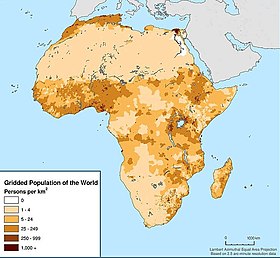
Population density of Africa (2000)
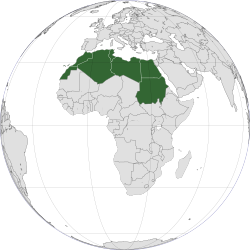
North Africa or Northern Africa is a region encompassing the northern portion of the African continent. In that location is no singularly accepted scope for the region, and information technology is sometimes defined as stretching from the Atlantic shores of Islamic republic of mauritania in the west, to Egypt's Suez Culvert.
Varying sources limit it to the countries of Algeria, Great socialist people's libyan arab jamahiriya, Morocco, and Tunisia, a region that was known by the French during colonial times as "Afrique du Nord" and is known by Arabs every bit the Maghreb ("Due west", The western part of Arab World).[1]
The United Nations definition includes Kingdom of morocco, People's democratic republic of algeria, Tunisia, Libya, Egypt, Sudan, and the Western Sahara, the territory disputed between Morocco and the Sahrawi Republic.[4]
The African Union definition includes the Western Sahara and Mauritania just not Sudan.[v] When used in the term Middle Due east and North Africa (MENA), it often refers only to the countries of the Maghreb.
North Africa includes the Spanish cities of Ceuta and Melilla, and plazas de soberanía and can also exist considered to include other Spanish, Portuguese and Italian regions such equally Canary Islands, Madeira, Lampedusa and Lampione.
The countries of North Africa share a little bit of ethnic, cultural and linguistic identity with the Middle East.
Northwest Africa has been inhabited by Berbers since the beginning of recorded history, while the eastern part of N Africa has been home to the Egyptians.[6] Betwixt the A.D. 600s and 1000s, Arabs from the Center E swept across the region in a wave of Muslim conquest. These peoples formed a single population in many areas, every bit Berbers and Egyptians merged into Arabic and Muslim culture. This procedure of Arabization and Islamization has defined the cultural mural of North Africa ever since.
The distinction between North Africa, the Sahel and the rest of the continent is every bit follows:
Nineteenth century European explorers, attracted past the accounts of Ancient geographers or Arab geographers of the classical period, followed the routes by the nomadic people of the vast "empty" space. They documented the names of the stopping places they discovered or rediscovered, described landscapes, took a few climate measurements and gathered rock samples. Gradually, a map began to fill in the white blotch.
The Sahara and the Sahel entered the geographic corpus past way of naturalist explorers because dehydration is the feature that circumscribes the boundaries of the ecumene. The map details included topographical relief and location of watering holes crucial to long crossings. The Arabic word "Sahel" (shore) and "Sahara" (desert) made its entry into the vocabulary of geography.
Latitudinally, the "slopes" of the arid desert, devoid of continuous homo habitation, descend in step-like mode toward the northern and southern edges of the Mediterranean that opens to Europe and the Sahel that opens to "Trab al Sudan." Longitudinally, a uniform grid divides the cardinal desert and then shrinks dorsum toward the Atlantic Ocean and the Red Sea. Gradually, the Sahara-Sahel is further divided into a total of xx sub-areas: cardinal, northern, southern, western, eastern, etc.
In this way, "standard" geography has determined dehydration to be the boundary of the ecumene. It identifies settlements based on visible activeness without regard for social or political organizations of infinite in vast, purportedly "empty" areas. It gives but cursory acknowledgement to what makes Saharan geography, and for that thing, globe geography unique: mobility and the routes by which it flows.
— An atlas of the Sahara-Sahel : geography, economics and security [7]
The Sahel or "African Transition Zone" has been affected by many determinative epochs in North African history ranging from the Ancient Roman colonization, the subsequent Arab expansion, to the Ottoman occupation.[8] [9] Every bit a result, many modern African nation-states that are included in the Sahel evidence cultural similarities and historical overlap with their North African neighbours.[10] In the present day, North Africa is associated with West Asia in the realm of geopolitics to form a Middle E-North Africa region.[11] The Islamic influence in the area is also significant, and N Africa is a major part of the Muslim world.
Geography [edit]
North Africa has 3 main geographic features: the Sahara desert in the south, the Atlas Mountains in the west, and the Nile River and delta in the due east. The Atlas Mountains extend across much of northern People's democratic republic of algeria, Morocco and Tunisia. These mountains are part of the fold mountain system that besides runs through much of Southern Europe. They recede to the southward and e, becoming a steppe landscape before coming together the Sahara desert, which covers more 75 percent of the region. The tallest peaks are in the Loftier Atlas range in s-central Morocco, which has many snow-capped peaks.
S of the Atlas Mountains is the dry out and barren expanse of the Sahara desert, which is the largest sand desert in the world.[12] In places the desert is cut by irregular watercourses called wadis—streams that menses only after rainfalls but are usually dry. The Sahara'due south major landforms include ergs, large seas of sand that sometimes form into huge dunes; the hammada, a level rocky plateau without soil or sand; and the reg, a level plain of gravel or small stones. The Sahara covers the southern office of Algeria, Morocco and Tunisia, and most of Libya. But 2 regions of Great socialist people's libyan arab jamahiriya are outside the desert: Tripolitania in the northwest and Cyrenaica in the northeast. Most of Egypt is also desert, with the exception of the Nile River and the irrigated land along its banks. The Nile Valley forms a narrow fertile thread that runs along the length of the country.
Sheltered valleys in the Atlas Mountains, the Nile Valley and Delta, and the Mediterranean declension are the main sources of fertile farming country. A wide variety of valuable crops including cereals, rice and cotton, and wood such equally cedar and cork, are grown. Typical Mediterranean crops, such as olives, figs, dates and citrus fruits, as well thrive in these areas. The Nile Valley is specially fertile and most of the population in Arab republic of egypt live close to the river. Elsewhere, irrigation is essential to improve crop yields on the desert margins.
Key information [edit]
| Countries and territories | Expanse (2016) (km2) | Population (2016) | Density (2016) (per km2) | Uppercase | Total GDP[13] (2016) (US$ billions) | GDP per capita[xiv] (2016) (US$) | Currency | Regime | Official languages |
|---|---|---|---|---|---|---|---|---|---|
| Algeria | two,381,740 | 40,606,052 | 17.05 | Algiers | $260,784 | $18,281 | Algerian dinar | Presidential republic | Arabic and Berber (both official), French is ordinarily used |
| Arab republic of egypt | 1,001,450 | 95,688,681 | 96 | Cairo | $332,349 | $12,554 | Egyptian pound | Semi-presidential republic | Arabic |
| Great socialist people's libyan arab jamahiriya | 1,759,540 | 6,293,253 | 3.58 | Tripoli | $33,157 | $8,678 | Libyan dinar | The states Acting Democratic provisional authority | Arabic |
| Morocco | 446,550 (undisputed), ~710,881 (claimed) | 35,276,786 | 73.1 | Rabat | $103,615 | $viii,330 | Moroccan dirham | Constitutional monarchy | Arabic and Berber (both official), French is usually used |
| Tunisia | 163,610 | 11,403,248 | 63 | Tunis | $41,869 | $11,634 | Tunisian dinar | Parliamentary democracy | Standard arabic, French is usually used. |
| Western Sahara / Sahrawi Arab Democratic Republic | 266,000 (total land expanse, control is divide between Morocco and the SADR) | 538,755 | 0.37 | disputed | disputed | disputed | disputed | disputed | Disputed: normally Arabic and French (Moroccan zone); commonly Arabic and Spanish (SADR zone) |
| Source: The World Banking company (12 Oct 2017) | |||||||||
People [edit]

The inhabitants of North Africa are roughly divided in a manner respective to the principal geographic regions of North Africa: the Maghreb, the Nile valley, and the Sahel. The Maghreb or western N Africa on the whole is believed to have been inhabited by Berbers since at least 10,000 B.C.,[15] while the eastern part of North Africa or the Nile Valley has mainly been dwelling to the Egyptians. Ancient Egyptians tape extensive contact in their Western desert with people that appear to have been Berber or proto-Berber. As the Tassili north'Ajjer and other stone art findings in the Sahara have shown, the Sahara also hosted various populations earlier its rapid desertification in 3500 B.C and even today continues to host small populations of nomadic trans-Saharan peoples.
The migration of the Banu Hilal and the Banu Sulaym due west into the Maghreb in the eleventh century introduced Arabic culture and language to the countryside. Historians mark their movement every bit a critical moment in the Arabization of North Africa.[16]
The official languages in the countries making up the Maghreb are Arabic, Tamazight equally a second official linguistic communication in Algeria and Morocco, and Spanish in Ceuta and Melilla. French is also used as an authoritative language in Algeria, Kingdom of morocco and Tunisia. The nearly spoken linguistic communication is Maghrebi Standard arabic, which is a course of ancient Arabic dating dorsum from the 8th century AD that follows a Berber grammatical and syntactical structure. For the remaining North African countries, the official language is Arabic. The largest ethnic groups in North Africa are Arabs, Berbers are considered the second largest ethnicity in north Africa in the west and the Arabs are a majority also in the east approaching the Middle East. The region is predominantly Muslim with a Jewish minority in Morocco, Algeria and Tunisia, and significant Christian minority—the Copts—in Egypt, Algeria,[17] Morocco[18] and Tunisia.[19]
The inhabitants of the Spanish Canary Islands are of mixed Castilian and North African Berber beginnings, and the people of Malta are of primarily Southern Italian/Sicilian, equally well every bit, to a bottom extent, Northward African and Middle Eastern ancestry[20] [21] [22] and speak a derivative of Arabic. However, these areas are not mostly considered part of N Africa, just rather Southern Europe, due to their proximity to mainland Europe and their European-based cultures and religion.
Culture [edit]
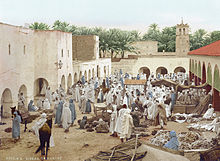
Marketplace of Biskra in Algeria, 1899
The people of the Maghreb and the Sahara regions speak Berber languages and several varieties of Arabic and almost exclusively follow Islam. The Arabic and Berber languages are distantly related, both being members of the Afroasiatic language family. The Tuareg Berber languages are notably more conservative than those of the coastal cities.
Over the years, Berbers accept been influenced by contact with other cultures: Egyptians, Greeks, Punic people, Romans, Vandals, Arabs, Europeans and Africans. The cultures of the Maghreb and the Sahara therefore combine indigenous Berber, Arab and elements from neighboring parts of Africa and beyond. In the Sahara, the distinction betwixt sedentary oasis inhabitants and nomadic Bedouins and Tuaregs is particularly marked.

The diverse peoples of North Africa are usually categorized along ethno-linguistic lines. In the Maghreb, where Arab and Berber identities are often integrated, these lines can exist blurred. Some Berber-speaking Northward Africans may identify as "Arab" depending on the social and political circumstances, although substantial numbers of Berbers (or Imazighen) accept retained a distinct cultural identity which in the 20th century has been expressed as a clear indigenous identification with Berber history and language. Arabic-speaking Northwest Africans, regardless of ethnic background, ofttimes place with Arab history and culture and may share a common vision with other Arabs. This, however, may or may not exclude pride in and identification with Berber and/or other parts of their heritage. Berber political and cultural activists for their role, often referred to as Berberists, may view all Northwest Africans every bit principally Berber, whether they are primarily Berber- or Arabic-speaking.
Egyptians over the centuries have shifted their language from Egyptian (in its late form, varieties of Coptic) to modern Egyptian Arabic while retaining a sense of national identity that has historically set up them autonomously from other people in the region. Nearly Egyptians are Sunni Muslim, although there is a significant minority of Coptic Christians.
The Maghreb formerly had a significant Jewish population, almost all of whom emigrated to French republic or Israel when the N African nations gained independence. Prior to the modern establishment of State of israel, there were almost 500,000 Jews in Northern Africa,[23] including both Sephardi Jews (refugees from Espana, France and Portugal from the Renaissance era) every bit well as indigenous Mizrahi Jews. Today, less than fifteen thousand remain in the region, nigh all in Kingdom of morocco and Tunisia, and are by and large part of a French-speaking urban elite. (See Jewish exodus from Arab and Muslim countries.)
History [edit]
Prehistory [edit]
Due to the contempo African origin of modern humans, the history of Prehistoric North Africa is important to the understanding of pre-hominid and early modern human history in Africa. Some researchers have postulated that North Africa rather than East Africa served as the leave betoken for the modernistic humans who showtime trekked out of the continent in the Out of Africa migration.[24] [25] [26] The earliest inhabitants of key North Africa have left behind significant remains: early remnants of hominid occupation in North Africa, for instance, were institute in Ain el Hanech, near Saïda (c. 200,000 BCE); in fact, more than contempo investigations take found signs of Oldowan applied science there, and indicate a date of up to 1.8 million BCE.[27] Recent finds in Jebel Irhoud in Morocco have been institute to contain some of the oldest Man sapiens remains; This suggests that, rather than arising just in Eastward Africa around 200,000 years ago, early Human being sapiens may already accept been present across the length of Africa 100,000 years earlier. According to study writer Jean-Jacques Hublin, "The idea is that early Human being sapiens dispersed around the continent and elements of human being modernity appeared in dissimilar places, and then different parts of Africa contributed to the emergence of what we telephone call modern humans today."[28] Early humans may take comprised a large, interbreeding population dispersed across Africa whose spread was facilitated past a wetter climate that created a "green Sahara", around 330,000 to 300,000 years ago. The rise of modern humans may thus have taken place on a continental scale rather than beingness confined to a particular corner of Africa.[29] In September 2019, scientists reported the computerized determination, based on 260 CT scans, of a virtual skull shape of the last common man antecedent to modernistic humans/H. sapiens, representative of the primeval modern humans, and suggested that modern humans arose between 260,000 and 350,000 years ago through a merging of populations in East and Southern Africa.[30] [31]
The cavern paintings found at Tassili n'Ajjer, n of Tamanrasset, Algeria, and at other locations depict vibrant and vivid scenes of everyday life in cardinal North Africa during the Neolithic Subpluvial period (most 8000 to 4000 BCE). Some parts of Due north Africa began to participate in the Neolithic revolution in the 6th millennium BCE, just before the rapid desertification of the Sahara around 3500 B.C. largely due to a tilt in the Earth'southward orbit.[32] Information technology was during this period that domesticated plants and animals were introduced in the region, spreading from the n and due east to the southwest.[33] At that place has been an inferred connection betwixt areas of rapid drying and the introduction of livestock in which the natural (orbital) aridification was amplified by the spread of shrubs and open up land due to grazing.[34] Nevertheless, changes in northern Africa's ecology after 3500 BCE provided the backdrop for the formation of dynastic civilizations and the structure of monumental architecture such as the Pyramids of Giza.[35]
When Egypt entered the Bronze Age,[36] the Maghreb remained focused on pocket-sized-calibration subsistence in small, highly mobile groups.[37] Some Phoenician and Greek colonies were established along the Mediterranean coast during the 7th century BCE.
Antiquity and aboriginal Rome [edit]
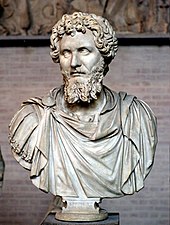
The first Roman emperor native to North Africa was Septimius Severus, built-in in Leptis Magna in present-solar day Libya.
The almost notable nations of antiquity in western N Africa are Carthage, Numidia and Mauretania. The Phoenicians colonized much of North Africa including Carthage and parts of present-day Kingdom of morocco (including Chellah, Essaouira and Volubilis[38]). The Carthaginians were of Phoenician origin, with the Roman myth of their origin existence that Dido, a Phoenician princess, was granted land by a local ruler based on how much state she could cover with a piece of cowhide. She ingeniously devised a method to extend the cowhide to a high proportion, thus gaining a large territory. She was also rejected by the Trojan prince Aeneas according to Virgil, thus creating a historical enmity between Carthage and Rome, every bit Aeneas would eventually lay the foundations for Rome. Aboriginal Carthage was a commercial power and had a strong navy, but relied on mercenaries for land soldiers. The Carthaginians developed an empire in the Iberian Peninsula, Malta, Sardinia, Corsica and northwest Sicily, the latter being the cause of First Punic War with the Romans.
Over a hundred years and more, all Carthaginian territory was eventually conquered by the Romans, resulting in the Carthaginian N African territories becoming the Roman province of Africa in 146 B.C.[39] This led to tension and somewhen conflict between Numidia and Rome. The Numidian wars are notable for launching the careers of both Gaius Marius, and Sulla, and stretching the constitutional burden of the Roman republic as Marius required a professional person army, something previously contrary to Roman values, to overcome the talented military leader Jugurtha.[40] Kingdom of Mauretania remained independent until being annexed to the Roman Empire past Emperor Claudius in 42 Advertizing.
North Africa remained a function of the Roman Empire, which produced many notable citizens such equally Augustine of Hippo, until incompetent leadership from Roman commanders in the early fifth century allowed the Germanic peoples, the Vandals, to cantankerous the Strait of Gibraltar, whereupon they overcame the fickle Roman defence. The loss of North Africa is considered a pinnacle signal in the fall of the Western Roman Empire equally Africa had previously been an of import grain province that maintained Roman prosperity despite the barbarian incursions, and the wealth required to create new armies. The issue of regaining North Africa became paramount to the Western Empire, just was frustrated by Vandal victories. The focus of Roman energy had to be on the emerging threat of the Huns. In 468 Advertising, the Romans made ane concluding serious attempt to invade North Africa but were repelled. This perhaps marks the point of terminal reject for the Western Roman Empire. The last Roman emperor was deposed in 476 past the Heruli full general Odoacer. Trade routes between Europe and Northward Africa remained intact until the coming of Islam. Some Berbers were members of the Early on African Church building (but evolved their own Donatist doctrine),[41] some were Berber Jews, and some adhered to traditional Berber organized religion. African pope Victor I served during the reign of Roman emperor Septimius Severus. Furthermore, during the rule of the Romans, Byzantines, Vandals, Ottomans and Carthaginians the Kabyle people were the only or one of the few in Northward Africa who remained contained.[42] [43] [44] [45] The Kabyle people were incredibly resistible so much and then that fifty-fifty during the Arab conquest of North Africa they yet had control and possession over their mountains.[46] [47]
Arab conquest to modernistic times [edit]
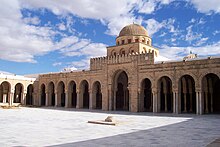
The early Muslim conquests included Northward Africa by 640. By 700, most of North Africa had come under Muslim rule. Indigenous Berbers afterward started to course their own polities in response in places such as Fez and Sijilmasa. In the eleventh century, a reformist motility made upwardly of members that called themselves the Almoravid dynasty expanded south into Sub-Saharan Africa.
North Africa's populous and flourishing civilization collapsed afterward exhausting its resource in internal fighting and suffering devastation from the invasion of the Banu Sulaym and Banu Hilal. Ibn Khaldun noted that the lands ravaged by Banu Hilal invaders had become completely barren desert.[49]

1803 Cedid Atlas, showing the Ottoman held regions of North Africa
After the Center Ages much of the area was loosely under the control of the Ottoman Empire. The Castilian Empire conquered several coastal cities between the 16th and 18th centuries. Afterward the 19th century, the imperial and colonial presence of France, the Uk, Spain and Italy left the entirety of the region nether 1 form of European occupation.
In World War Two from 1940 to 1943 the area was the setting for the Due north African Campaign. During the 1950s and 1960s all of the North African states gained independence. There remains a dispute over Western Sahara between Morocco and the Algerian-backed Polisario Forepart.
The wider protest movement known as the Arab Spring began with revolutions in Tunisia and Arab republic of egypt which ultimately led to the overthrow of their governments, also as civil war in Libya. Large protests as well occurred in Algeria and Kingdom of morocco to a lesser extent. Many hundreds died in the uprisings.[l]
Science and technology [edit]
Further information in the sections of History of science and technology in Africa:
- Pedagogy
- Astronomy
- Mathematics
- Metallurgy
- Medicine
- Agronomics
- Textiles
- Maritime technology
- Architecture
- Advice systems
- Warfare
- Commerce
- By country
Transport and manufacture [edit]

Thousands of people in North Africa depend on engagement palm copse for a living. Tunisia in 1960
The economies of People's democratic republic of algeria and Libya were transformed by the discovery of oil and natural gas reserves in the deserts. Morocco's major exports are phosphates and agricultural produce, and every bit in Arab republic of egypt and Tunisia, the tourist industry is essential to the economy. Egypt has the most varied industrial base, importing technology to develop electronics and applied science industries, and maintaining the reputation of its high-quality cotton textiles.
Oil rigs are scattered throughout the deserts of Libya and Algeria. Libyan oil is peculiarly prized because of its low sulfur content, which means it produces less sulfur dioxide than other fuel oils.
Meet also [edit]
 Geography portal
  Africa portal
- Demographics of the Middle Due east and North Africa
- Civilization of Egypt
- European Digital Archive on Soil Maps of the Earth
- List of mod conflicts in North Africa
References [edit]
- ^ a b Brett, Michael. "Definition: N Africa (region, Africa)". Encyclopedia Britannica. Retrieved 9 September 2021.
- ^ Mattar, Philip (i June 2004). Encyclopedia of the Modernistic Centre East and North Africa . Macmillan Reference Usa. ISBN9780028657691.
- ^ De facto government of parts of Western Sahara, claimant to the whole area).
- ^ Sectionalization, United nations Statistics. "UNSD — Methodology". unstats.un.org.
- ^ "The Associates – African Union". au.int.
- ^ National Geographic Geno Project: Egyptians are N Africans
- ^ An atlas of the Sahara-Sahel : geography, economics and security. Bossard, Laurent., Organisation for Economical Co-operation and Development., Sahel and West Africa Club., OECD iLibrary. Paris. ISBN978-9264222342. OCLC 900622439.
{{cite book}}: CS1 maint: others (link) - ^ es-Sadi, Abderrahman (1898). Tarikh es soudan (in Arabic). Paris Due east. Leroux.
- ^ Andrew, McGregor (2001). "The Circassian Qubbas of Abbas Avenue, Khartoum: Governors and Soldiers in 19th Century Sudan" (PDF). Nordic Journal of African Studies. Archived from the original (PDF) on 15 February 2019. Retrieved 25 October 2018.
- ^ "Northward Africa and the African Transition Zone". 17 June 2016.
- ^ Güney, Aylın; Gökcan, Fulya (February 2012). "The 'Greater Middle East' as a 'Mod' Geopolitical Imagination in American Foreign Policy". Geopolitics. fifteen: 22–38. doi:10.1080/14650040903420370.
- ^ "Largest Desert in the World". Retrieved 30 Dec 2011.
- ^ "World Economic Outlook Database". International Monetary Fund. eighteen Apr 2017.
- ^ Globe Economic Outlook Database, April 2016, International Monetary Fund. Database updated on 12 April 2016. Accessed on 14 April 2016.
- ^ Hsain Ilahiane, Historical Dictionary of the Berbers (Imazighen)(2006), p. 112
- ^ Anthony Appiah; Henry Louis Gates (2005). Africana: The Encyclopedia of the African and African American Experience. Oxford University Printing. p. 360. ISBN978-0-19-517055-9.
- ^ *(in French) Sadek Lekdja, Christianity in Kabylie, Radio France Internationale, 7 mai 2001 Archived 18 Oct 2017 at the Wayback Machine
- ^ "Refworld – Morocco: General state of affairs of Muslims who converted to Christianity, and specifically those who converted to Catholicism; their treatment by Islamists and the regime, including land protection (2008–2011)". Refworld.org.
- ^ Fahlbusch, Erwin (2003). The Encyclopedia of Christianity: J-O. Wm. B. Eerdmans Publishing. ISBN978-0-8028-2415-8.
- ^ Genetic Origin of Gimmicky Maltese People.
Repopulation is likely to take occurred by a clan or clans (possibly of Arab or Arab-like speaking people) from neighbouring Sicily and Calabria. Mayhap, they could have mixed with minute numbers of residual inhabitants, with a constant input of immigrants from neighbouring countries and later, fifty-fifty from afar. At that place seems to be little input from N Africa.
- ^ Geoffrey Hull, The Malta Linguistic communication Question: A Case Study in Cultural Imperialism, Valletta: Said International, 1993, pp. 317-330. Scientific etymologies of the longest-established Maltese family names are given in Geoffrey Hull, "The Oldest Maltese Surnames: A Window on Sicily's Medieval History", in Claudia Karagoz and Giovanna Summerfield (eds), Sicily and the Mediterranean: Migration, Substitution, Reinvention, New York: Palgrave Macmillan, 2015, pp. 78-108; "Late Medieval Maltese Surnames of Arabic and Greek Origin", Symposia Melitensia No. xi (2015), pp. 129-143
- ^ Genetic Origin of Contemporary Maltese People.
Together with colleagues from other institutions across the Mediterranean and in collaboration with the group led by David Goldstein at the University College, London, we have shown that the contemporary males of Malta nearly likely originated from Southern Italian republic, including Sicily and up to Calabria. In that location is a minuscule amount of input from the Eastern Mediterranean with genetic analogousness to Christian Lebanon....We documented clustering of the Maltese markers with those of Sicilians and Calabrians. The study is published in the Annals of Human Genetics by C. Capelli, N. Redhead, Northward. Novelletto, L. Terrenato, P. Malaspina, Z. Poulli, G. Lefranc, A. Megarbane, V. Delague, V. Romano, F. Cali, 5.F. Pascali, M. Fellous, A.East. Felice, and D.B. Goldstein; "Population Structure in the Mediterranean Basin; A Y Chromosome Perspective", AHG, 69, 1-xx, 2005..
- ^ "Jews of the Maghreb on the eve of Earth State of war Two". encyclopedia.ushmm.org . Retrieved 18 February 2022.
- ^ Balter, Michael (7 January 2011). "Was North Africa the Launch Pad for Modern Human Migrations?". Science. 331 (6013): 20–23. Bibcode:2011Sci...331...20B. doi:10.1126/science.331.6013.20. PMID 21212332.
- ^ Cruciani, Fulvio; Trombetta, Beniamino; Massaia, Andrea; Destro-Bisol, Giovanni; Sellitto, Daniele; Scozzari, Rosaria (2011). "A Revised Root for the Human y Chromosomal Phylogenetic Tree: The Origin of Patrilineal Diverseness in Africa". The American Journal of Man Genetics. 88 (6): 814–818. doi:ten.1016/j.ajhg.2011.05.002. PMC3113241. PMID 21601174.
- ^ Hublin, Jean-Jacques; Boutakiout, Mohamed; Eggins, Stephen; Grün, Rainer; Reid, Donald J.; Tafforeau, Paul; Smith, Tanya Thousand. (10 April 2007). "Earliest prove of mod human life history in N African early Homo sapiens". Proceedings of the National Academy of Sciences. 104 (15): 6128–6133. Bibcode:2007PNAS..104.6128S. doi:10.1073/pnas.0700747104. PMC1828706. PMID 17372199.
- ^ "Sahnouni 1998" (PDF). Gi.ulpc.es. Archived from the original (PDF) on 10 May 2013. Retrieved 10 Baronial 2018.
- ^ "Eritrea's human rights record comes nether fire at United Nations". The Guardian. Associated Press. 25 October 2013. Retrieved thirty October 2013.
- ^ Gibbons, Ann (7 June 2017). "World'due south oldest Homo sapiens fossils found in Morocco". Science . Retrieved 8 June 2017.
- ^ Zimmer, Carl (x September 2019). "Scientists Find the Skull of Humanity's Ancestor — on a Reckoner - Past comparison fossils and CT scans, researchers say they have reconstructed the skull of the last common forebear of modern humans". The New York Times . Retrieved 10 September 2019.
- ^ Mounier, Aurélien; Lahr, Marta (2019). "Deciphering African late heart Pleistocene hominin diverseness and the origin of our species". Nature Communications. x (i): 3406. Bibcode:2019NatCo..10.3406M. doi:10.1038/s41467-019-11213-w. PMC6736881. PMID 31506422.
- ^ "Dark-green Sahara: African humid periods paced past World's orbital changes". Science Daily. 12 July 1999. Archived from the original on 29 Oct 2013.
- ^ Kuper, Rudolf (2006). "Climate-Controlled Holocene Occupation in the Sahara: Motor of Africa's Evolution". Science. 313 (5788): 803–708. Bibcode:2006Sci...313..803K. doi:10.1126/science.1130989. PMID 16857900. S2CID 20003260.
- ^ Wright, David (2017). "Humans as Agents in the Termination of the African Humid Period". Frontiers in Earth Scientific discipline. 5: https://doi.org/ten.3389/feart.2017.00004. Bibcode:2017FrEaS...5....4W. doi:x.3389/feart.2017.00004.
- ^ Gatto, Maria (2015). "Holocene supra-regional ecology changes every bit trigger for major socio-cultural processes in northeastern Africa and the Sahara". African Archaeological Review. 32 (ii): 301–333. doi:10.1007/s10437-015-9191-x. S2CID 126834892.
- ^ Bader, Bettina (2015). Egypt and the Mediterranean in the Bronze Historic period: The Archaeological Bear witness. doi:10.1093/oxfordhb/9780199935413.013.35. ISBN978-0-19-993541-three.
- ^ Barker, Graema (2005). "Agronomics, Pastoralism, and Mediterranean Landscapes in Prehistory". The Archaeology of Mediterranean Prehistory: 46–76. doi:10.1002/9780470773536.ch3. ISBN9780470773536.
- ^ C. Michael Hogan (eighteen Dec 2007). "Volubilis – Aboriginal Village or Settlement in Morocco". The Megalithic Portal. Retrieved 23 May 2010.
- ^ The Punic Wars 264–146 BC, by Nigel Bagnall
- ^ Sallust, De Bello Iugurthino
- ^ The Berbers BBC World Service: The Story of Africa
- ^ Eur. The Middle Eastward and North Africa: Pg 156. ISBN9781857431322.
- ^ Walmsley, Hugh Mulleneux (1858). "Sketches of Algeria During the Kabyle State of war By Hugh Mulleneux Walmsley: Pg 118".
- ^ Wysner, Glora G. (xxx Jan 2013). The Kabyle People By Glora M. Wysner. ISBN9781447483526.
- ^ The Encyclopedia Americana, Volume ane: Pg 568. 1990. ISBN9780717201211.
- ^ "The fine art periodical London, Book iv: Pg 45". 1865.
- ^ Field, Henry Martyn (1893). "The Barbary Coast By Henry Martyn Field: Pg 93".
- ^ Küng, Hans (2006). Tracing The Way: Spiritual Dimensions of the World Religions. A&C Black. ISBN978-0-8264-9423-8. , page 248
- ^ Populations Crises and Population Cycles Archived 27 May 2013 at the Wayback Auto, Claire Russell and W.M.Due south. Russell, Galton Institute, March 1996
- ^ Essa, Azad (21 February 2011). "In search of an African revolution". Al Jazeera.
Further reading [edit]
- Cesari, Jocelyne. The enkindling of Muslim democracy: Religion, modernity, and the country (Cambridge University Printing, 2014).
- Fischbach, ed. Michael R. Biographical encyclopedia of the modern Center Eastward and Due north Africa (Gale Group, 2008).
- Ilahiane, Hsain. Historical dictionary of the Berbers (Imazighen) (Rowman & Littlefield, 2017).
- Issawi, Charles. An economic history of the Heart Due east and North Africa (Routledge, 2013).
- Naylor, Phillip C. North Africa, Revised Edition: A History from Antiquity to the Present (University of Texas Printing, 2015).
External links [edit]
- Human Rights for Indigenous Peoples
- Northward Africa's Weather Forecasts and Atmospheric condition Atmospheric condition
- Due north Africa news and analysis
- Africa Interactive Map from the Usa Ground forces Africa
cusackcoubjecruir92.blogspot.com
Source: https://en.wikipedia.org/wiki/North_Africa
0 Response to "What Continent Is Just to the North of Libya"
Post a Comment